Letters of Recommendation
This page provides some insight into what letter writers are asked to provide for applicants. For a stronger letter of recommendation, be sure to work with your letter writer outside of classes. Otherwise, weaker letters of recommendation may focus only on academic performance in a particular course and not provide admissions committees with much insight into your ability to succeed in graduate school or other opportunities.
Requesting Letters of Recommendation
Never list someone as a reference or recommendation provider if the person has not agreed to provide a recommendation for you! Always ask potential letter writers first, and wait until they agree to provide a recommendation before entering their information into application systems.
Timing. Please provide multiple weeks for letter writers to complete and submit recommendations. As a general rule, please ask at least 3 weeks before the recommendation is due. Earlier is better! Instructors of large enrollment courses often receive multiple requests for letters during each application cycle, and we may only have time to accept a limited number of requests each time (for example, 5 requests). Asking early greatly increases your chance of getting a letter writer to agree to provide a recommendation!
If you ask <1-2 weeks before a recommendation is due, be prepared for the letter writer to decline. If you are planning to apply to more than 2-3 institutions, then you should provide more than 3 weeks notice. The recommendation process is not just a single letter — it also involves answering each institution’s unique set of ratings/questions about applicants (see below for examples of questions that letter writers must answer). Some institutions do not ask for a PDF letter but instead ask specific unique questions that must be answered in separate text boxes. Every institution is different!
Materials to provide. When requesting a letter of recommendation, be prepared to provide the letter writer with:
- a brief summary of how you know the letter writer
- for instructors, a brief summary of how the course or specific assignments helped prepare you for where you are applying (be sure to provide specific examples instead of general statements — what, specifically, helped you the most?)
- list of institutions you plan to apply to, along with deadlines for each
- a copy of your resume/CV
- a completed FERPA form that allows instructors to discuss academic performance in letters
Right to Review a Recommendation. You should strongly consider waiving your right to review a recommendation. Waiving this right indicates that you trust the person providing the recommendation. If you choose to not waive your right to review a recommendation, then the person providing the recommendation may feel that you do not trust them and may provide a recommendation that is not candid. Recommendations could be interpreted as less impactful by admissions committees if the applicant chooses to not waive the right to review (they may wonder if the recommendation is candid and truthful). If you choose to not waive your right to review a recommendation, then discuss this decision with the potential recommendation provider when you ask if they will provide a recommendation. Be sure to discuss reasons why you prefer *not* waiving your right so that there are no misunderstandings. However, be prepared for some people to decline to provide a recommendation if you do not waive your right to review the recommendation.
Tasks for Letter Writers
Letters of recommendation often require more than just a letter. Many institutions require letter writers to complete a form that explains how long they have known the applicant, how the applicant compares against others, and ratings for several aspects like ‘ability to solve problems’ and ‘ability to work independently’. Every institution has a different form to fill-out.
Sample Questions
Here’s a sample of questions from various recommendation systems:
- How long have you known this applicant and in what capacity?
- When evaluating the applicant, please indicate which comparison group you are considering. For instance, are you comparing them to all undergrads, your advisees, etc.
- Rate the applicant on the following skills and aptitudes:

- Rate the applicant on the following character traits:
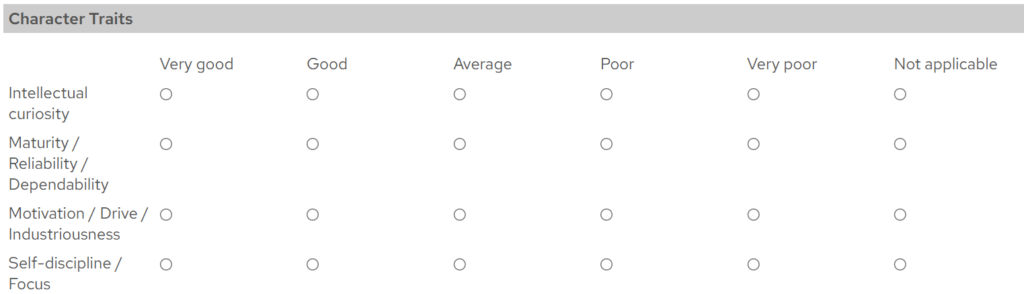
- What is your overall assessment of the applicant for graduate study? (strongly recommend, recommend, recommend with reservations, do not recommend, etc.)
- Comment on 3 strengths of the applicant.
- Comment on 3 weaknesses of the applicant and explain how they could improve.
- Upload the letter. Example prompts from various institutions:
- We would appreciate your candid assessment of the candidate’s capabilities and motivation for graduate study. Please indicate in what capacity you have known the applicant. Does the applicant demonstrate the personal and intellectual qualities required in a graduate program? How does the applicant compare with other students who have entered similar programs? What are the applicant’s strengths and weaknesses?
- Please give a brief overall assessment of the applicant’s qualifications for success in graduate study, including strengths and weaknesses. If applicable, please also comment on the applicant’s research experience.
Weaker Recommendations
A weaker recommendation often involves the letter writer focusing only on academic performance in specific courses. Looking at the sample questions above, weak recommendations often mean most of the ratings are entered as ‘not applicable’ or ‘unable to judge’ — and that doesn’t provide much insight for an admissions committee that is reviewing letters.
For example, if a letter writer provides a recommendation for a student who was enrolled in a course but did not interact or work with the instructor outside of class, the ‘skills’ ratings might be marked as:

Stronger Recommendations
A stronger recommendation often involves working with a letter writer outside of classwork so that the letter writer can actually answer many of the questions in the sample above. A strong recommendation letter will be able to provide specific examples of interactions outside of class and justify the provided ratings for skills, aptitudes, and character traits.
Your goal when identifying letter writers should involve finding a letter writer who is able to answer questions like the samples listed above! That also means you may have to find opportunities to work with potential letter writers outside of class, or at least interact with letter writers outside of the classroom. Examples of working with letter writers outside of class include:
- regular interactions during office hours
- regular contributions to course message board threads
- interactions during student group events
- completing independent study projects with a letter writer
- serving as a grader or teaching assistant for a letter writer
- completing the senior design course with the letter writer as your technical advisor